Demystifying EN 14065: A Practical Guide to RABC for Healthcare Laundry
For the supervisors of hospitals, care homes or other specialized healthcare laundries, managing the microbiological standards in processed textiles is a required part and parcel of care management, and not a reasonable option for the facility managers to avoid this. It’s about much more than scrubbing — it’s an essential component of infection prevention and control. The European Standard EN 14065, "Risk Analysis and Biocontamination Control (RABC) system," sets the gold standard for addressing this risk. The book is an accessible guide to the implementation of EN 14065, the actual procedures are from discussion till follow up to meet the legal standard and maintain patient safety.
A Review of the EN 14065 System and RABC.
EN 14065, which was first published in 2016 and is regularly reviewed (including a project in revision launched May 2024), is a dynamic, process-oriented standard. It requires a proactive risk management approach, in contrast to a prescriptive checklist. Its key principle is known as RABC system and is intended to allow laundries to provide continuous assurance of microbiological quality, as changes in the specific facility do not mean a one-size-fits-all solution. Internationally, EN 14065 is also a case benchmark. Leading hospitals such as Peking Union Medical College Hospital in China have integrated its principles into their laundry design and operations, for one thing. Its influence is global, serving as an example in best practices for textile processing practices within healthcare.
Core Components of RABC System.
RABC Implementation The method you are taking is to implement controlled processes and processes at each step. The system rests on multiple core principles, frequently viewed as a circular progression:
1. Risk Analysis: Determine and assess all potential entry points for biocontamination, such as collecting soiled linen, storage in clean facilities, and use in cleaning facilities.
2. Control Points & Limits: Define the critical control points (CCPs) and set strict, measurable limits (e.g., minimum wash temperature/time; chemical concentration).
3. Monitoring & Documentation: Define procedures to monitor each CCP and keep accurate records—the mainstay of any audit.
4. Corrective Actions: When your scrutiny shows you are violating a certain limit, ensure that you have a clear plan.
5. Validation & Verification: Periodically verify that your processes such as wash cycles decontaminate textiles accurately and that the system as a whole is functioning as expected.
Main Control Points during the Wash Process.
Disinfection phase is one of CCP central to. According to EN 14065 and its equivalent literature, we propose methods with a clear approach to the achievement of microbiological safety:
l Thermal Disinfection The best method of heat safe clothing. Measurement of effectiveness has been obtained using A0 (the parameter which incorporates temperature and time). A0 ≥ 600 is a popular target, and can be reached by using combinations such as 90°C for 1 minute, 80°C for 10 minutes or 70°C for 100 minutes. This flexibility enables energy-efficient low-temperature cycles provided time is provided for an appropriate period.
l Chemo-Thermal Disinfection: For temperature sensitive fabrics, a mixture of lower temperatures (60-65°C) plus approved disinfectants (such as peroxygen-based chemistries) is used. The most important prerequisite is effective pre-washing, since organic soils protect microorganisms greatly and significantly reduce the efficacy of disinfectant. Waste disposal using only high heat tumble dryer or ironer does not provide high heat for drying, as ‘dry heat’ is less effective than ‘moist heat’ and the time taken for dry area was not long enough.
Building Design: Physical Contamination Constraint.
RABC design should take the form of a laundry’s physical layout. At the heart of it is the rigidity, of "bad" and "clean" workflows that no cross-contamination can happen to the system at large.
A compliant layout features:
l Specialized Zones: Pretended areas free of impurities or toxic substances, typically enclosed by a wall.
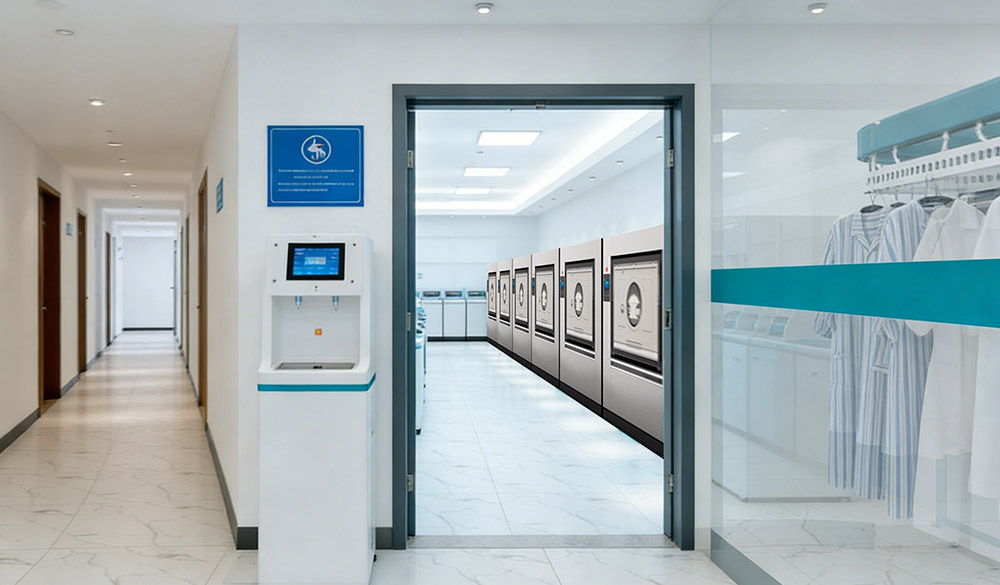
l Unidirectional Flow: The textiles, people, and air have to flow in one direction, from dirty to clean to no longer be backsliding. It requires separate entrances and hallways.
l Staff Protocols: Staff should be assigned to separate changing facilities, and hygiene protocols should be enforced for transferring between zones.
Modern barrier washer-extractors are built for this situation. They are installed in the dividing wall to load off the dirty side and displace into the clean area, so to speak, serving as the most perfect physical and procedural control place.
We go from compliance to the competitive advantage. EN 14065’s RABC system is not only an exercise in regulatory knowledge; it is an investment in quality and safety. It offers a systematic approach to addressing infection risks, offers defensible proof of due diligence, and maintains trust with healthcare clients. The standard gives laundries assessing equipment clear requirements: Machines should provide accurate, repeatable, and confirmed thermal or chemo-thermal disinfection cycles. It is here that features such as programmable cycle logic or accurate temperature control, or chemical injection systems, become critical. Moreover, devices which enable optimum workflow separation, like barrier-type machines, directly correspond to the underlying RABC mandate to avoid cross-contamination. Combining these guidelines into processes design and technical decisions will allow the healthcare laundries to transition a complex set of standards into a simplified, safe, and sustainable approach.